[MOOC] Apollo Lesson 1: SDC Fundamentals
· 4 min read · 604 words

This is my note for lesson 1 of MOOC course: Self-Driving Fundamentals - Featuring Apollo. Content: Identify the key parts of self-driving cars. The Apollo team and architecture.
Human vs Self-driving Car
| Human | Self-Driving Car |
|---|---|
| High traffic accident rate | More reliable driving |
| Learn to drive from scratch | Learnable driving system |
| Parking trouble | No parking trouble |
Six levels of self-driving car
-
Level 0: Base level - No autonomous task
-
Level 1: Driver assistance
- Driver Fully Engaged
-
Level 2: Partial Automation
- Automatic Cruise Control
- Automatic Lane Keeping
-
Level 3: Conditional Automation
- Human Take Over Whenever Necessary
-
Level 4: No Human Interference
- Without Steering Wheel, Throttle or Brake
- Restricted in Geofence
-
Level 5: Full Automation
Apollo platform
1. Hardware
-
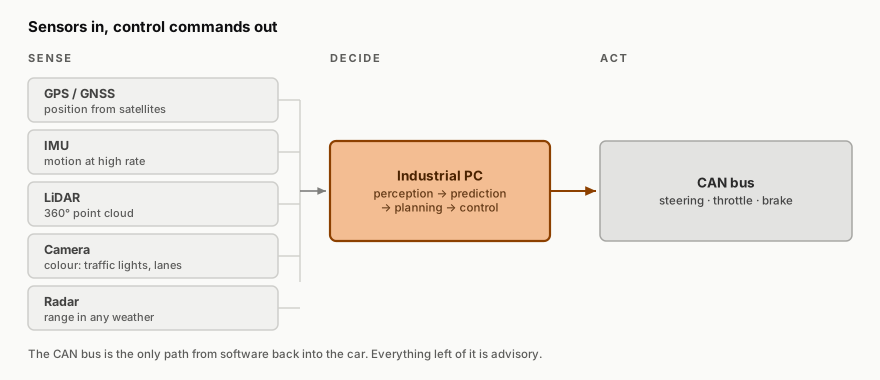
The Controller Area Network (CAN) cars is how the computer system connects to the car internal network to send signals for acceleration, braking and steering.
-
The Global Positioning System (GPS) receives signals from satellites, circling the earth. These signal help to determine our location.
-
The Inertial Measurement Unit (IMU) measure the vehicle movement and location by tracking the position, speed, acceleration and other factors.
-
LiDAR is an array of pulse layers. The LiDAR of Apollo can scan 360 degrees around the vehicle. The reflection of these lazer beams builds the point cloud that our software can use to understand the environment.
-
Cameras can be used to capture environment. For example because cameras can perceive color, they can be use to detect and understanding traffic lights.
-
Radar is also used for detecting obstacle. However, it's difficult to understand what kind of obstacle that radar has detected. Advantages: it's economical, it works in all weather and lighting condition.
2. Open Software Stack
Sublayers:
- Real-time operating system (RTOS)
- Runtime framework
- Application modules
Real-time operating system (RTOS)
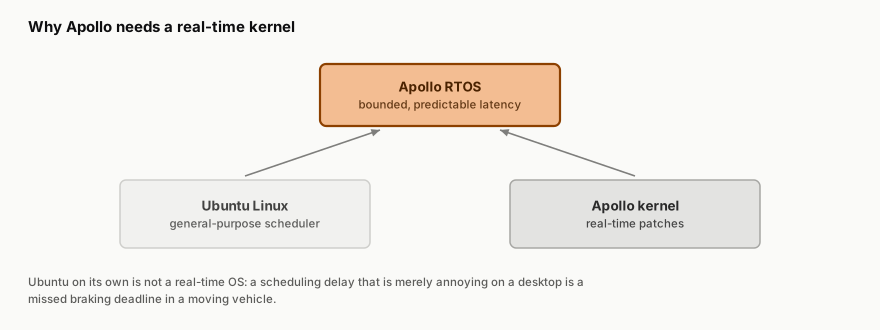
Apollo RTOS is a combination of Ubuntu linux and the Apollo kernel.
- Ubuntu is popular but not a RTOS.
- Ubuntu + Apollo kernel -> RTOS.
Runtime framework: Customized ROS (Robot Operation System)
To adapt ROS for self-driving cars, the Apollo teams has:
- Improve functionality
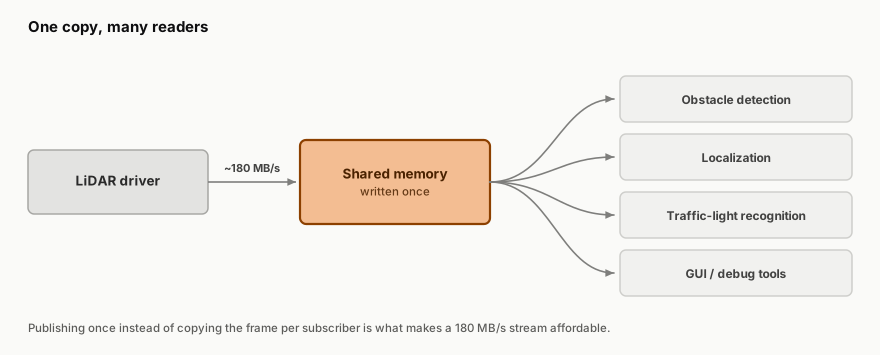
- Improve performance for shared memory, decentralization and data comparability
Apollo uses shared memory
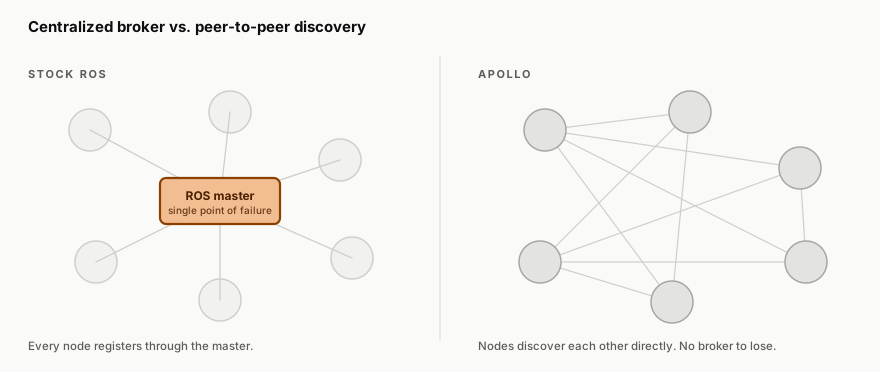
Apollo decentralize ROS architecture
Stock ROS routes every node registration through a single master. Lose the master and the graph stops forming, which is an unacceptable failure mode in a moving vehicle. Apollo replaces it with peer-to-peer discovery, so there is no broker left to lose.
Apollo used Protobuf instead of native ROS Message for data comparability between different versions of the system
3 Apollo Cloud Service
- HD Map
- Simulation
- Data platform
- Security
- OTA
Apollo Github
Link to Github repo: https://github.com/ApolloAuto/apollo.
Keep reading
- [MOOC] Autoware Course - Lecture 1 - Setup the environment
Lecture 1 notes from the Apex.AI Autoware course: getting the development environment up with Docker, ROS 2, Terminator, and Autoware.Auto, the errors I hit along the way, and how I fixed them.
- [MOOC] Apollo Lessons on Self-Driving Cars
Course notes from Udacity's Self-Driving Fundamentals, featuring Apollo. What the seven lessons cover, from HD maps and localization through perception, prediction, planning, and control. Every diagram in the series is redrawn.
- [MOOC] Apollo Lesson 7: Control
Lesson 7: steering, throttle, and brake that follow the planned trajectory while keeping passengers comfortable. PID, LQR, and model predictive control, with the tradeoffs of each.