Efficiency Frontier plot for object detection on the COCO2017 dataset (validation) comparing YOLO-NAS vs. other YOLO architectures.
**YOLO-NAS** is approximately 0.5 mAP points more accurate and **10-20%** faster than equivalent versions of **YOLOv8** and **YOLOv7**. ## Advancement 1: Architecture Search for YOLO **AutoNAC™**, Deci's proprietary Neural Architecture Search technology, was responsible for generating the YOLO-NAS model. This framework is designed to optimize the inference speed and accuracy of deep neural networks considering the given task and hardware constraints. By using **AutoNAC™**, Deci was able to create a new YOLO architecture that is more accurate and faster than SOTA YOLO models, including YOLOv8. ## Advancement 2: Ready for Post-Training Optimization [VGG](https://paperswithcode.com/method/vgg) is a very famous traditional CNN architecture. It is known for its simplicity and effectiveness. However, it is not very efficient in terms of speed and memory. To solve this problem, [RepVGG](https://arxiv.org/abs/2101.03697) was proposed. RepVGG is a simple yet powerful architecture that is based on VGG. It is designed to be more efficient in terms of speed and memory. With re-parameterization, RepVGG can be trained with multi-branch architecture and then converted to a single branch for faster inference. 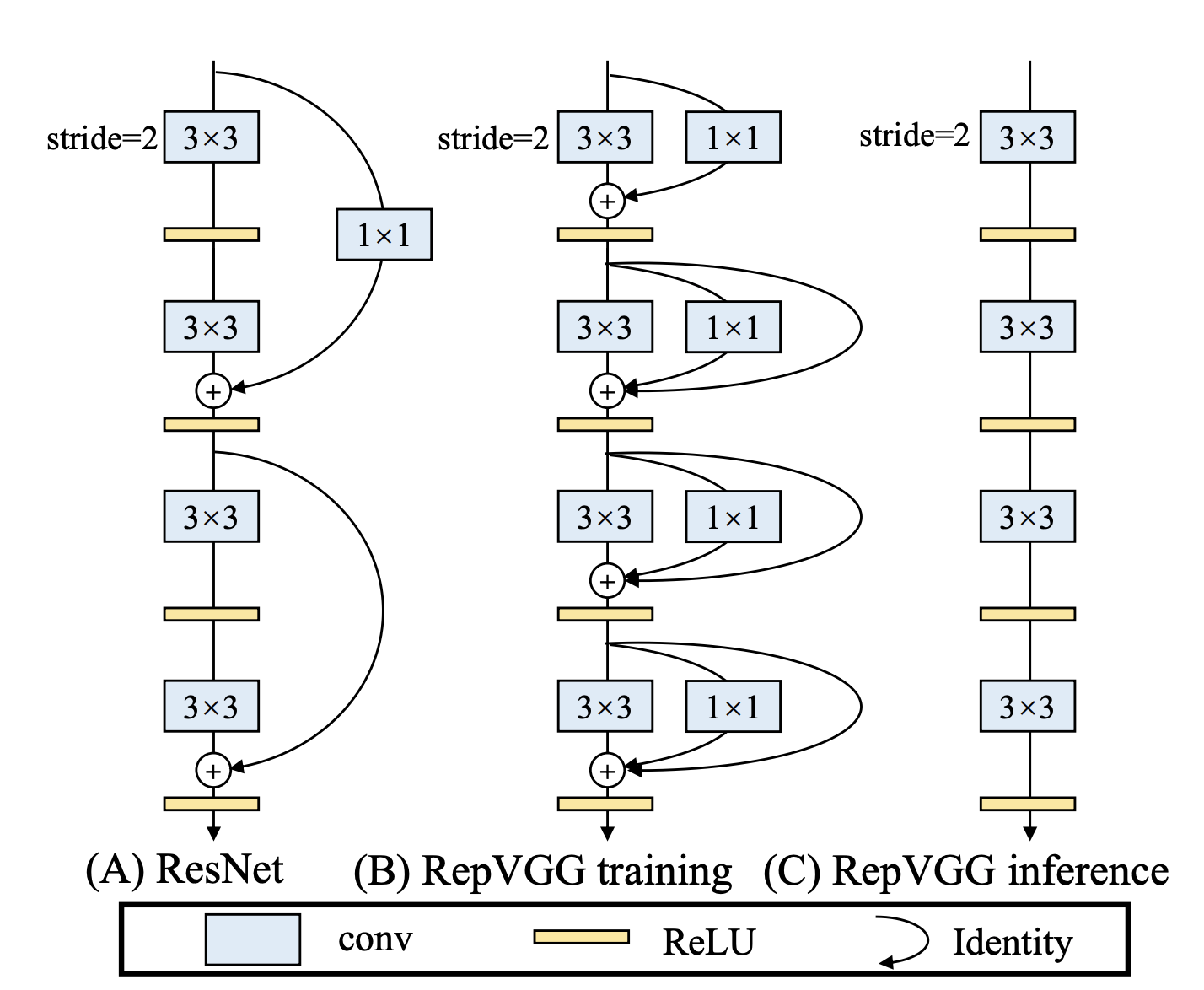Sketch of RepVGG architecture - image from the original paper.
By using RepVGG, the architecture of YOLO-NAS can be optimized after training by re-parameterization and is also compatible with Post-training Quantization. This is a very important feature for production deployment. The model can be trained with full precision and then optimized for inference speed and memory usage. ## Advancement 3: Quantization-Aware Training Post-training Quantization enables users to create a highly efficient quantized integer model for inference. However, despite careful post-training calibration, model accuracies may be compromised to the extent that is unacceptable. When this occurs, post-training calibration alone is insufficient for generating a quantized integer model. Instead, it becomes necessary to train the model in a manner that accounts for the quantization effect. This is where Quantization Aware Training comes in, as it has the capability to model the quantization effect during training. 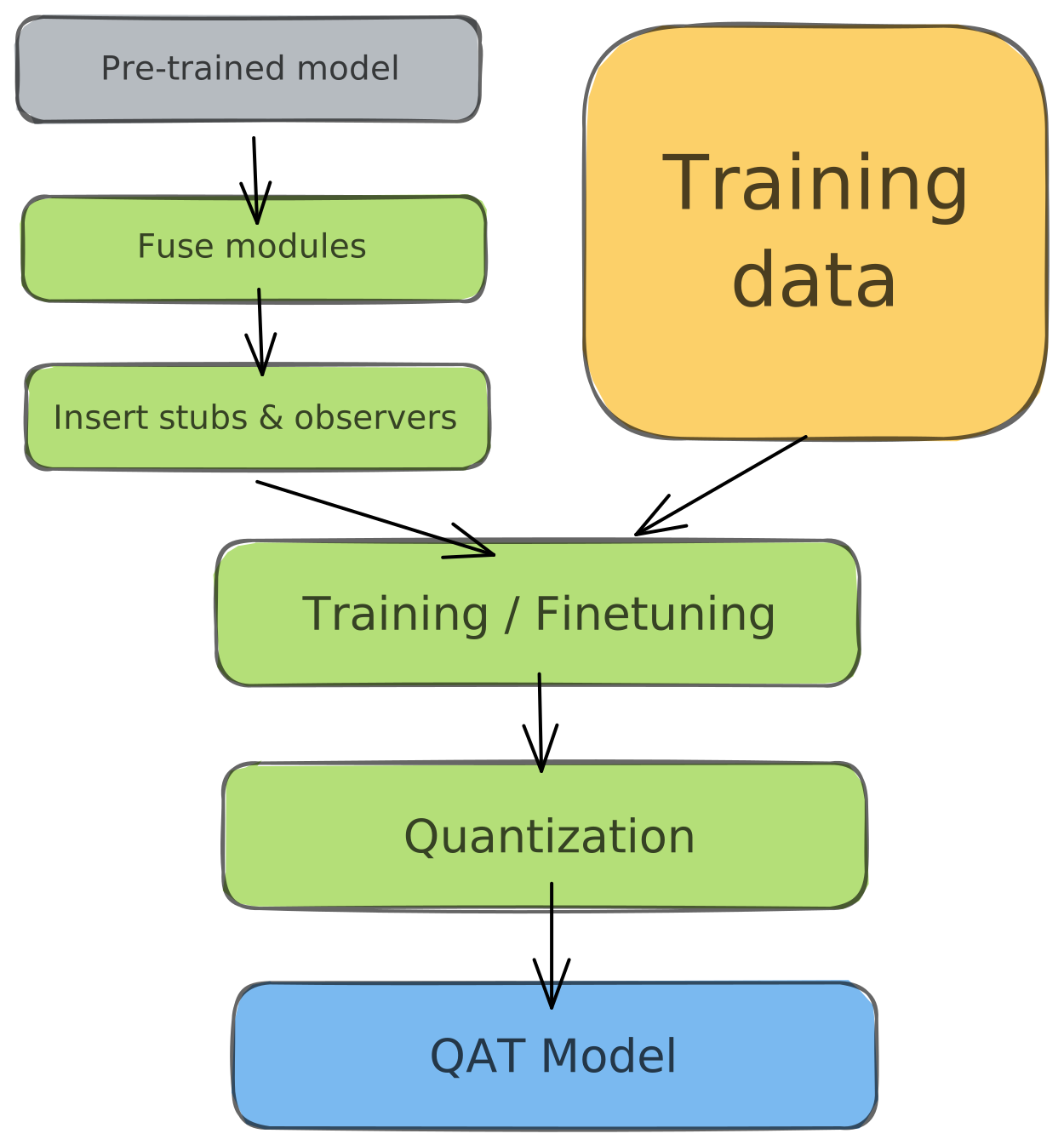Steps in Quantization-Aware Training. Source: https://pytorch.org/blog/quantization-in-practice/.
Utilizing quantization-aware blocks and selective Quantization, YOLO-NAS employs an architecture that optimizes its performance. The design of this model includes adaptive Quantization, which skips Quantization in certain layers depending on the balance between accuracy loss and latency/throughput improvement. When the model is converted to its INT8 quantized version, YOLO-NAS experiences a smaller precision drop compared to other models, losing only **0.51**, **0.65**, and **0.45** points of mAP for its S, M, and L variants, respectively. This is in contrast to other models that experience a loss of 1-2 mAP points during Quantization. These innovative techniques contribute to an architecture with exceptional object detection capabilities and superior performance. ## Advancement 4: Training Strategy The training process of YOLO-NAS was enhanced by different techniques such as **Preuso-labeled Data**, **Knowledge Distillation**, and **Distribution Focal Loss**. With these techniques, they can create SOTA pre-trained models with the Object365 dataset, in 25-40 epochs, depending on the model variant. **Distribution Focal Loss** utilizes box regression as a classification task by discretizing box predictions into a set of finite values. It then predicts probability distributions over these values, which are ultimately transformed into final predictions via a weighted sum. **Knowledge Distillation** is a technique that transfers knowledge from a large model to a smaller model. By this method, the lightweight models can achieve better performance by learning the knowledge (probability distribution) from the large model instead of from the dataset only. In the case of YOLO-NAS, the student model learns from both the classification and DFL prediction of the teacher model. Knowledge Distillation Mechanism
## Try: YOLO-NAS **Deci AI** released [super-gradients](https://github.com/Deci-AI/super-gradients/blob/master/YOLONAS.md) library - the easy way to use YOLO-NAS. You can try it on your own data and see the results. ```python import super_gradients yolo_nas = super_gradients.training.models.get("yolo_nas_l", pretrained_weights="coco").cuda() yolo_nas.predict("https://deci-pretrained-models.s3.amazonaws.com/sample_images/beatles-abbeyroad.jpg").show() ``` **Some results from YOLO-NAS L:** 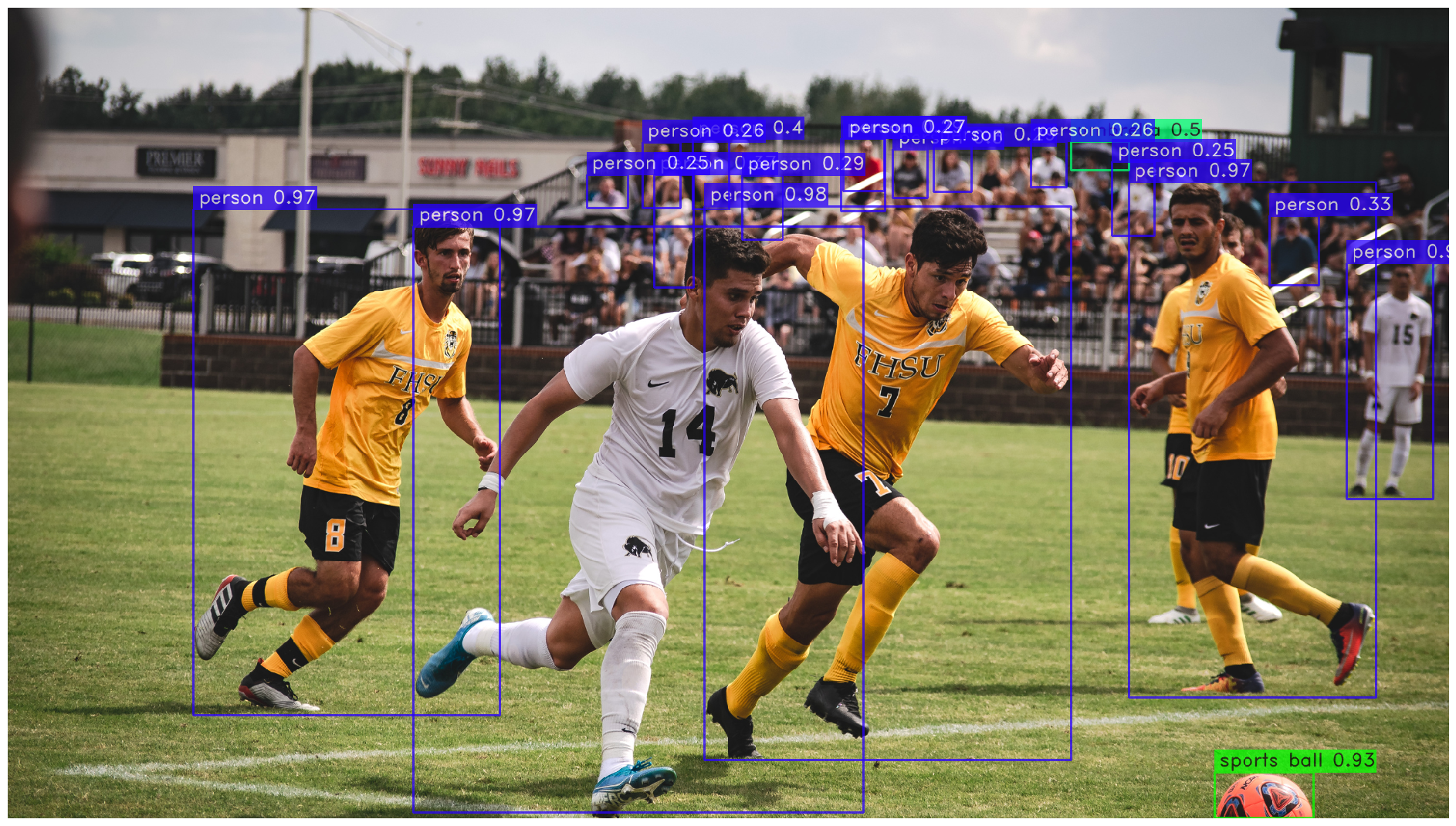 **Football image from Canva** 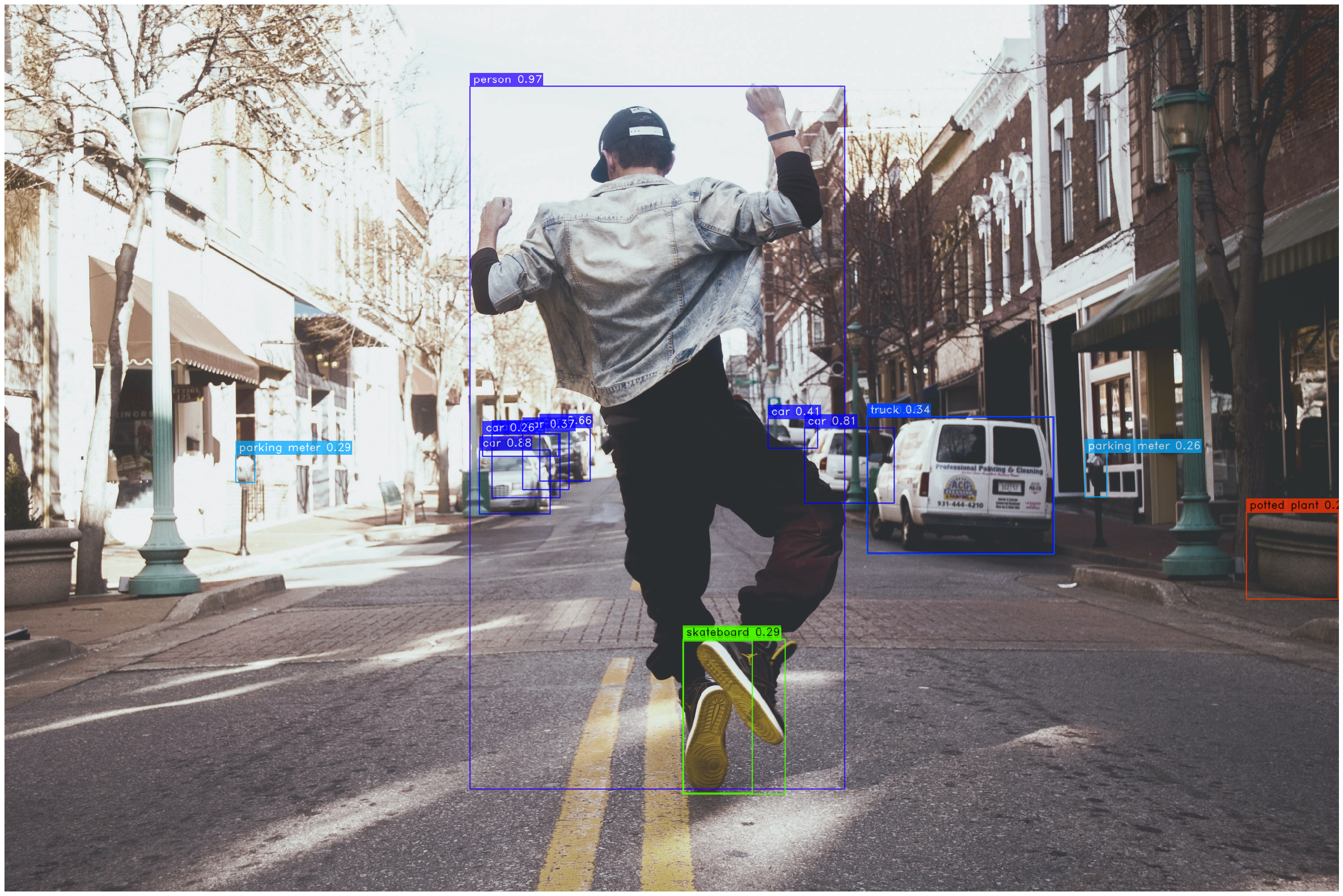 **Street from Unsplash** ## Training your own models **YOLO-NAS** provides source code and documentation for finetuning the model and training it from scratch. The training code supports both quantization-aware training and post-training Quantization. - [Finetuning notebook](https://github.com/Deci-AI/super-gradients/blob/master/LICENSE.YOLONAS.md) with your custom data. - [YOLO-NAS Quantization-Aware training and post-training Quantization](https://github.com/Deci-AI/super-gradients/blob/master/documentation/source/qat_ptq_yolo_nas.md). ## License and Commercial Use The source code for **YOLO-NAS** is available under the [Apache 2.0 license](https://github.com/Deci-AI/super-gradients/blob/master/YOLONAS.md) - integrated into the [super-gradients](https://github.com/Deci-AI/super-gradients/blob/master/YOLONAS.md) library. However, the pre-trained weights are available **for non-commercial use only**. Read more at [YOLO-NAS WEIGHTS LICENSE](https://github.com/Deci-AI/super-gradients/blob/master/LICENSE.YOLONAS.md). Therefore, if you are going to use this model for a commercial project, you may need to **check the license and retrain the model** from scratch. ## Conclusion **YOLO-NAS** is a new state-of-the-art object detection model that is faster and more accurate than previous YOLO models. It is also more efficient in terms of memory usage and inference speed. This project was developed "with production use in mind" as they support inference engines like NVIDIA TensorRT seamlessly. Let's try this model today for your projects and see how it performs!